



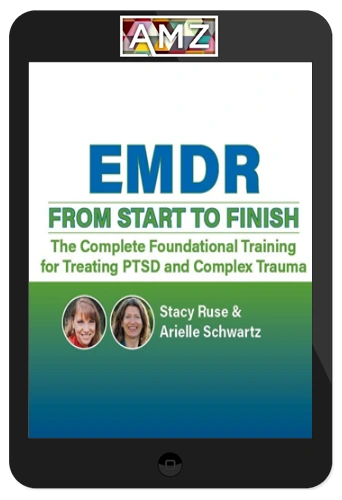
Stacy Ruse & Arielle Schwartz – EMDR From Start To Finish
Original price was: $199.99.$90.00Current price is: $90.00.
»Instant Delivery
Stacy Ruse & Arielle Schwartz – EMDR From Start To Finish
Introducing our first ever EMDR Foundations course — a step-by-step training on how to use EMDR therapy to safely and effectively treat any kind of trauma.
Join two of the most sought-after Certified EMDR instructors, Stacy Ruse and Arielle Schwartz, as they teach you a highly empirically validated and rapid treatment…
…so you can help clients gently reprocess trauma and free themselves from their painful pasts — with many clients experiencing significant improvement in just a few sessions.
Learn Stacy and Arielle’s distinctively integrative and client-led approach that will help you create a compassionate and customized healing environment for each unique client you treat.
What you’ll learn in EMDR From Start To Finish
What You Need to Know Before Starting EMDR
- Bottom-up stabilization strategies for bodily connection and alignment
- Practical Polyvagal & Neuroscience
- Trauma symptomology presentations & what they mean
- Why the relationship between “window of tolerance” and dual attention matters
- Impact of intergenerational trauma, ACES, and more
- Integrative somatic, CBT, narrative therapy and EMDR techniques for memory reprocessing
- How to encourage post-traumatic growth early in treatment
Get Started with EMDR Therapy
- Know when and how to start EMDR safety
- Proper assessment for trauma and dissociation
- Methods, forms, use, and set-up of Bilateral Stimulation
- Must-know red-flags in trauma processing
- Determine client suitability & readiness for trauma processing
- Handle crises, suicidality, substance use, etc.
- Identity treatment risks, limitations and potential roadblocks
- EMDR research as evidence-based treatment & comparison research
The AIP Model: How EMDR Incorporates Adaptive Information Processing
- EMDR as an integrative approach
- Harness the power of the active components of EMDR
- Clinical implications of using dual awareness
- Core principles, focus, and clinical understanding
- Know the 3-Pronged Approach
Fundamentals & Demonstrations of the EMDR Standard Protocol & 8 Phases
- Real demonstrations of the 8 Phase Model, complete and incomplete sessions
- Know what to treat first: Single and multiple issues presentations
- Accurate and effective history taking, case conceptualization, and treatment planning
- Expert preparation & safe resourcing
- Practice the effective EMDR interventions (Container, calm place, etc.)
- Setting up the EMDR Protocol for an EMDR Session
- Demos of complete and incomplete EMDR sessions
Step-by-Step Instruction of EMDR 8-Phase Model
- History & Treatment Planning
- Past, Present, & Future Prongs
- Preparation & Resources review
- Assessment & Target Set-up
- Mechanics and set-up details
- Stop signal and metaphors
- Goals & TICES
- Identifying effective Negative & Positive Cognitions
- Floatback Technique
- Channels
- Desensitization
- Begin processing phase
- EMDR classic statements
- When to return to target
- Taking SUD
- Titrating target
- Stuck processing, feeder memories, blocking beliefs, and more
- Installation
- Goals
- Installation of positive cognition & VoC
- Body scan
- Goals & Procedure
- Closure
- Goals & Instruction
- Closing completes target & closing incomplete session
- Re-evaluation
- Goals & other considerations
- Demonstrations and Practice Reprocessing Phase of EMDR
EMDR Additions, Adaptations & Overcome Challenges
- Overcome Deadlock, Blocking & Looping
- Practice Protocol and Interweaves
- Use Cognitive Interweaves and Parts Interweaves
- Working with anger, guilt, shame, & other common problems
- Types, make up, and examples of interweaves
- Working with Parts of Self & Part interweaves
- Somatic & Attachment-based EMDR for resolving Relational Trauma
- Considerations and adaptations working with children & adolescents
- Best practices for virtual EMDR
- Legal and ethical consideration
More courses from the same author: Stacy Ruse & Arielle Schwartz
Related products

»Instant Delivery
Sixty Skills – Developing Clairvoyance, Clairaudience and Clairgustance

»Instant Delivery

»Instant Delivery
»Instant Delivery
Sixty Skills – Transference of Consciousness and the Grain of Sand

»Instant Delivery

»Instant Delivery
Sixty Skills – How to Learn Kabbalah from the Spirit World Via Evocation

»Instant Delivery
Marnie Greenberg – Pre-Program Your Life For Health, Wealth & Happiness

»Instant Delivery
Daniel J. Fox – Antisocial Borderline Narcissistic and Histrionic
Total sold: 1